Preparing for Cambridge examinations requires more than reading textbooks and memorizing important concepts. Students also need regular examination practice to understand question patterns, improve problem-solving skills and manage their time effectively.
Two commonly used resources for Cambridge students are topical past papers and yearly past papers. Both play an important role in examination preparation, but they serve different purposes.
Many O Level and A Level students in Pakistan often ask whether they should practise topical questions first or start solving complete yearly examination papers.
The answer depends on your preparation level, subject requirements and examination goals. In this guide, we will explain the difference between topical vs yearly past papers, their benefits and how students can use both resources to prepare more effectively.
What Are Topical Past Papers?
Topical past papers are examination questions organized according to individual subjects and topics. Instead of providing a complete examination paper, they collect questions related to specific chapters or syllabus areas.
For example, an O Level Physics topical paper may contain questions about electricity, waves, energy and thermal physics separately.
This approach allows students to practise one topic at a time after completing its textbook lessons.
Benefits of Topical Past Papers
Topical papers are particularly useful during the learning and revision stages.
Some important benefits include:
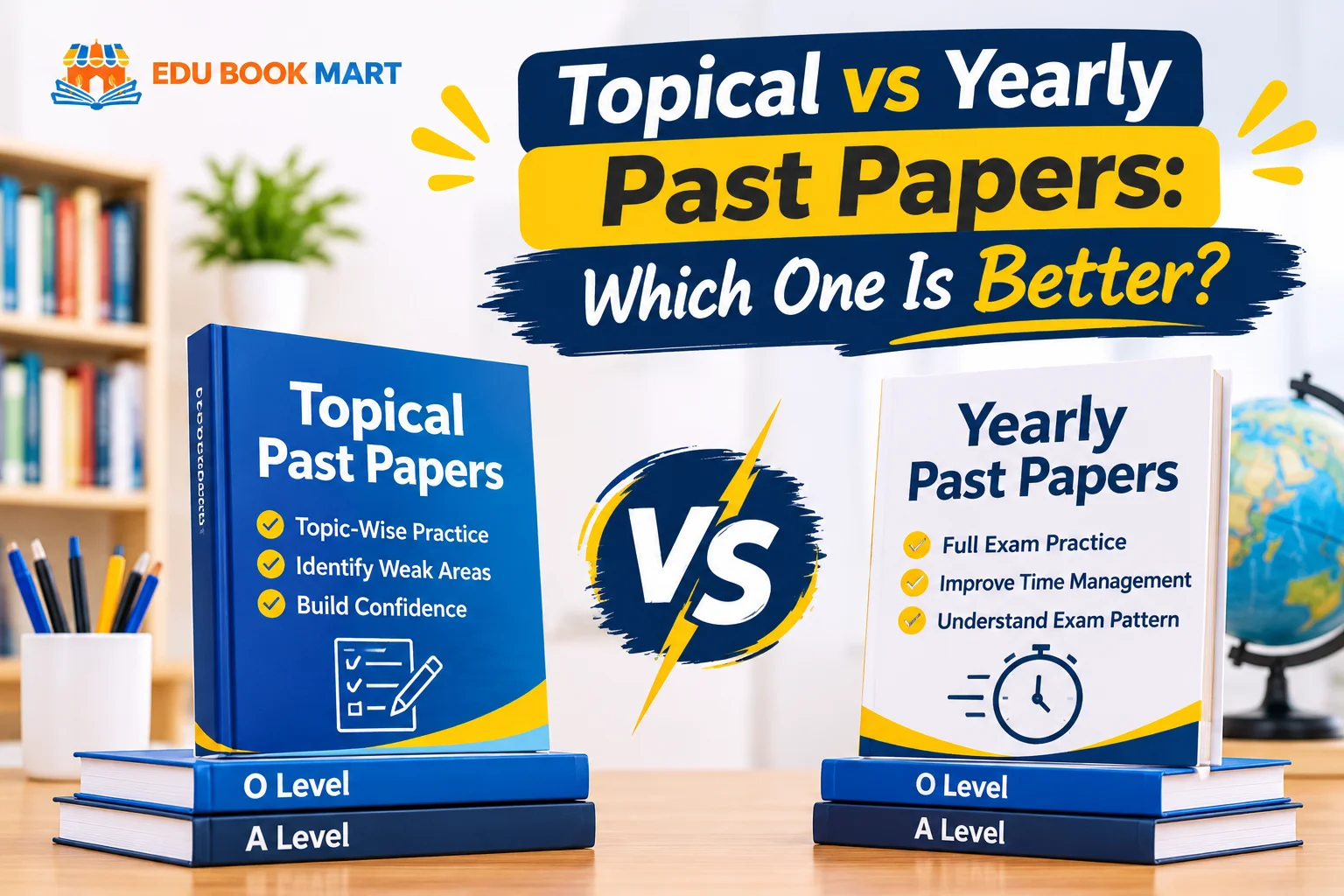
- Topic-Wise Practice: Students can practise questions from individual chapters.
- Identify Weak Areas: Regular practice helps students recognize topics that require additional attention.
- Improve Conceptual Understanding: Repeated questions help students understand how examination concepts are applied.
- Build Confidence: Students can gradually improve their understanding before attempting complete examination papers.
- Focused Revision: Topical questions make it easier to revise specific syllabus areas.
For example, after completing the algebra chapter in Mathematics, students can solve relevant topical questions to check their understanding.
Students can explore the CAIE O Level Topical Papers collection at Edu Book Mart to find subject-specific examination practice resources.
What Are Yearly Past Papers?
Yearly past papers are complete examination papers arranged according to examination sessions and years.
Unlike topical papers, these resources contain different questions from multiple syllabus topics in one examination paper.
Students can use yearly papers to understand the overall examination structure and practise answering questions within the allocated time.
For example, a student preparing for an O Level Chemistry examination can attempt a complete paper from a previous examination session.
Benefits of Yearly Past Papers
Yearly past papers are especially valuable when students have completed most of their syllabus and want to evaluate their preparation.
Their main benefits include:
- Understand Examination Structure: Students become familiar with the format and organization of complete examination papers.
- Improve Time Management: Timed practice helps students learn how to manage examination time.
- Test Overall Preparation: Students can evaluate their understanding across multiple topics.
- Develop Exam Techniques: Regular practice helps students understand how to approach different question types.
- Identify Knowledge Gaps: Complete papers can reveal topics that still require additional revision.
Students can browse the CAIE O Level Yearly Papers category at Edu Book Mart for examination practice resources.
Topical vs Yearly Past Papers: Key Differences
Although both resources contain previous examination questions, their purposes are different.
Here is a comparison to help students understand which resource is more suitable for their preparation.
| Comparison | Topical Past Papers | Yearly Past Papers |
| Organization | Topic-wise | Year-wise and session-wise |
| Main purpose | Improve individual topic understanding | Evaluate overall preparation |
| Question coverage | Specific syllabus topics | Multiple topics |
| Best preparation stage | During learning and revision | After completing major syllabus areas |
| Practice style | Focused practice | Complete examination practice |
| Main benefit | Identifying weak topics | Improving exam readiness |
| Time management | Usually less focused on full-paper timing | Helps develop timed examination skills |
Both resources are useful, but students should understand when to use each one.
Which Is Better: Topical or Yearly Past Papers?
There is no single answer for every student because both types of past papers support different stages of examination preparation.
However, topical papers are generally a better starting point for students who are still learning individual chapters.
Once students understand the syllabus and have practised important topics, yearly papers become more valuable for testing their overall preparation.
Here is how to decide.
When Should Students Use Topical Past Papers?
Topical papers are a suitable choice when:
- You have recently completed a chapter.
- You need additional practice with difficult concepts.
- You want to identify weak areas in a particular subject.
- You are preparing for chapter-based tests.
- You need to improve your understanding before attempting complete papers.
For example, an A Level Biology student can practise questions about cell membranes, enzymes, or transport after completing the relevant topics.
When Should Students Use Yearly Past Papers?
Yearly papers are useful when:
- You have completed most of your syllabus.
- You understand the important concepts.
- You want to practise complete examination papers.
- You need to improve time management.
- You want to evaluate your examination readiness.
Students should attempt yearly papers under realistic examination conditions to get a better understanding of their performance.
Should O Level and A Level Students Use Both?
Yes. Using both topical and yearly past papers can create a more balanced examination preparation strategy.
O Level and A Level students have different subject requirements, but both can benefit from combining topic-based learning with complete examination practice.
Topical and Yearly Papers for O Level Students
O Level students should begin by understanding their textbook chapters and practising related topical questions.
For subjects such as Mathematics, Physics, Chemistry and Biology, topic-wise practice can help students understand how concepts appear in examination questions.
After completing the syllabus, students can start attempting yearly papers to evaluate their overall preparation.
Topical and Yearly Papers for A Level Students
A Level subjects often require deeper conceptual understanding and more advanced application of knowledge.
Students should use topical papers to practise challenging areas before moving towards complete yearly examination papers.
For example, A Level Mathematics students can practise Pure Mathematics, Mechanics and Statistics questions separately before attempting complete examination papers.
Edu Book Mart also provides resources for different Cambridge qualifications. Students can explore the CAIE A Level Topical Papers category for additional subject-wise practice.
Best Strategy to Use Topical and Yearly Past Papers Together
Instead of choosing only one type of past paper, students should develop a preparation routine that includes both.
The following approach can help make examination preparation more organized.
Step 1: Understand the Official Syllabus
Start by reviewing the latest syllabus for your examination board and subject.
Identify all required topics and divide them into manageable sections.
Step 2: Study from the Textbook
Read the relevant textbook chapters and understand important concepts before attempting examination questions.
Make short revision notes for formulas, definitions, theories and difficult topics.
Step 3: Practise Topical Past Papers
After completing each chapter, solve relevant topical questions.
Review your answers and identify areas that need additional practice.
Step 4: Attempt Yearly Past Papers
Once you have covered the major syllabus areas, start attempting complete yearly papers.
Use the official examination time limit and avoid checking answers during the practice session.
Step 5: Review Your Mistakes
After completing a paper, compare your answers with the relevant mark scheme.
Identify repeated mistakes, revise weak topics and practise similar questions again.
Step 6: Repeat the Process
Continue alternating between focused topical practice and complete yearly papers until your examination.
Consistency is more important than attempting a large number of papers without reviewing your mistakes.
Common Mistakes Students Should Avoid
Although past papers are valuable study resources, using them incorrectly can reduce their effectiveness.
Here are some common mistakes students should avoid:
- Ignoring the Syllabus: Do not assume that every question from older papers is relevant to your current examination.
- Skipping Topical Practice: Moving directly to complete papers without understanding individual topics can make preparation difficult.
- Memorizing Answers: Focus on understanding concepts rather than memorizing previous examination answers.
- Ignoring Mark Schemes: Mark schemes explain the expected answers and marking requirements.
- Avoiding Timed Practice: Students should practise complete papers under examination conditions.
- Not Reviewing Mistakes: Simply completing past papers is not enough; students must understand their errors.
A structured approach can help students get more value from their examination resources.
Where to Find Topical and Yearly Past Papers in Pakistan?
Finding suitable examination practice material is important for O Level and A Level students.
Edu Book Mart provides educational resources for Cambridge students, including subject-specific topical papers, yearly examination papers, textbooks and revision notes.
Students can explore available resources through its online store and select materials according to their examination board, subject and syllabus requirements.
Before purchasing any past paper collection, check the subject code, examination sessions, available years and whether the material includes solutions or mark schemes.
Choosing the correct resources can make examination preparation more organized and convenient.
Final Talk
Both topical and yearly past papers play important roles in Cambridge examination preparation. However, they serve different purposes and should be used at the appropriate stages of learning.
Topical past papers are useful for practising individual chapters, improving conceptual understanding and identifying weak areas. On the other hand, yearly past papers help students evaluate their overall preparation, understand examination formats and improve time management.
For the best results, O Level and A Level students should combine both resources instead of depending on only one.
Start with topic-wise practice, gradually move towards complete examination papers and review your mistakes regularly. With the right study materials and a consistent preparation routine, students can approach their Cambridge examinations with greater confidence.
Frequently Asked Questions (FAQs)
1. What is the difference between topical and yearly past papers?
Topical past papers organize questions according to individual topics, while yearly past papers contain complete examination papers arranged by year and session.
2. Are topical past papers better than yearly past papers?
Topical papers are better for focused chapter practice, while yearly papers are more useful for complete examination preparation. Both are important for effective learning.
3. When should O Level students start solving yearly past papers?
Students should start attempting complete yearly papers after understanding most of their syllabus and practising important topics.
4. Are topical past papers useful for A Level students?
Yes. Topical papers help A Level students practise advanced concepts and identify difficult areas in subjects such as Mathematics, Physics, Chemistry and Biology.
5. How many past papers should students solve before examinations?
There is no fixed number. Students should focus on consistent practice, relevant syllabus coverage, timed examination attempts and reviewing their mistakes.
6. Should students solve past papers with mark schemes?
Yes. Mark schemes help students understand expected answers, marking requirements and areas where they can improve.
7. Where can I buy topical and yearly past papers in Pakistan?
Students can explore Edu Book Mart for Cambridge O Level and A Level topical papers, yearly papers and other examination preparation resources.
8. Can I prepare for Cambridge exams using only past papers?
Past papers are useful for examination practice, but they should not replace textbooks, classroom learning and understanding the official syllabus. A combination of different study resources is more effective.