

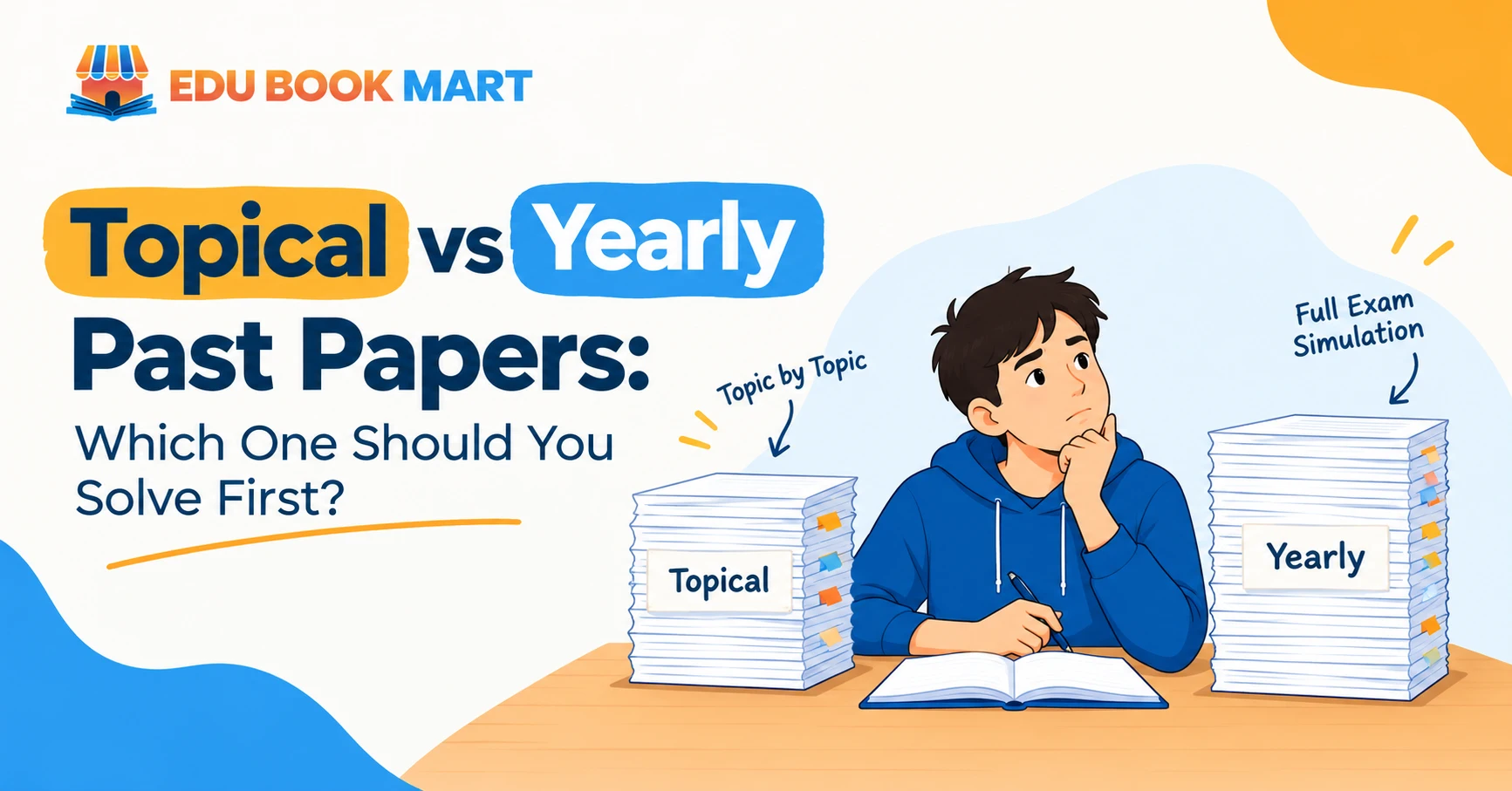
Solve topical past papers first, then move to yearly papers. Topical papers group questions by syllabus topic, so they suit the stage when you are still learning chapter by chapter. Yearly papers recreate a complete exam, so they belong in the final eight to ten weeks when timing matters as much as knowledge.
Almost every Cambridge and Edexcel student buys past papers. Far fewer know which type to buy, or when. Students who start yearly papers in the first term usually burn through their best practice material before they have covered the syllabus, then panic in the last month with nothing fresh left. Students who never move past topical books walk into the hall knowing their content but running out of time in Paper 2.
This guide explains what each type is, what each one trains, and the order that works for most students.
What Are Topical Past Papers?
Topical past papers take questions from many exam sessions and regroup them by syllabus topic instead of by year. Every question ever asked on electricity sits in one chapter. Every organic chemistry question sits in another. The year and session are usually printed next to each question, and most books carry the matching mark schemes.
That structure changes how you can use them. You do not have to wait until you have finished the whole syllabus. Finish a chapter in class on Tuesday, and you can practise ten real exam questions on that exact chapter on Wednesday, while the material is still fresh.
Topical books are widely available for CAIE O Level, IGCSE and A Level subjects, and for a smaller set of Edexcel GCSE subjects.
Three things they do well:
- Reinforce a topic immediately after you learn it, instead of months later
- Expose repeating patterns, because examiners return to the same ideas in different wording
- Let you attack a weak chapter directly, rather than hunting for its questions across fifteen separate papers
What Are Yearly Past Papers?
Yearly past papers keep each paper intact, exactly as students sat it. May June 2023 Paper 2 appears in full, in its original question order, with its original mark distribution and its own mark scheme. Nothing is regrouped.
That makes them a poor learning tool and an excellent testing tool. A yearly paper does not care that you have not covered thermal physics yet. It jumps from one topic to an unrelated one, gives you no warning, and puts a clock on the whole thing.
What they train:
- Working to the real time limit, which is where most lost marks actually come from
- Switching between unrelated topics without losing focus
- Deciding which question to attempt first and how long to spend on it
- Staying calm when a question lands on your weakest topic
Topical vs Yearly Past Papers: The Key Differences
| Topical past papers | Yearly past papers | |
| How questions are arranged | Grouped by syllabus topic across many years | Kept exactly as they appeared in one exam session |
| Best stage to use them | While you are still studying, and in early revision | Final eight to ten weeks before the exam |
| What they build | Topic mastery and question pattern recognition | Timing, stamina and exam temperament |
| Length of one sitting | 20 to 40 minutes | A full paper, one to two and a half hours |
| Main risk | You already know the topic before you read the question | Using them too early wastes papers you cannot replace |
| How you mark them | Question by question, straight after attempting | Whole paper first, then a full analysis |
Neither type replaces the other. They train different things, and a student who uses only one of them will feel the gap on exam day.
Which One Should You Solve First?
Topical first, in almost every case. The reason is simple. Practice only helps when you have something to practise. Attempting a full yearly paper before you have covered two thirds of the syllabus produces a low score, a demoralised student, and a used paper that can no longer serve as a clean mock later.
Yearly papers are a limited resource. There are only so many past sessions, and once you have seen a paper you cannot unsee it. Spend them at the point where they teach you the most, which is the last stretch before the exam.
If your exam is six months or more away
Stay almost entirely on topical papers. Work through them chapter by chapter, in step with what you are being taught. One yearly paper every six weeks is enough, purely so the full paper format does not feel unfamiliar later.
If your exam is six to ten weeks away
Flip the ratio. Two full yearly papers a week under strict timed conditions, and topical papers used only on the specific chapters where those yearly papers show you are losing marks. This is the phase where scores climb fastest, because you are fixing identified weaknesses rather than revising blindly.
If you are retaking or improving a grade
Start with topical papers on the two or three topics that cost you the most marks last time, then return to yearly papers. Repeating the same broad revision that produced your previous grade rarely changes it.
How to Use Topical Past Papers Properly
1. Finish learning the chapter before you open the topical book. These are practice questions, not teaching material.
2. Attempt eight to twelve questions from that topic, working from the oldest session towards the newest.
3. Mark strictly against the mark scheme. Do not award yourself half a mark for nearly correct wording. Cambridge examiners will not.
4. For every mark lost, write down why: a concept you did not know, a command word you misread, or a careless slip. Those three problems need three different fixes.
5. One week later, redo only the questions you got wrong. If you get them right without help, the topic is closed.
6. Watch for repetition. When the same idea appears in four different sessions, that is the examiner telling you it is core to the syllabus.
How to Use Yearly Past Papers Properly
1. One full paper in a single sitting, to the official time limit, no notes and no phone. Half a paper on the sofa teaches you nothing about timing.
2. Choose a range of five to eight recent sessions, then work from the oldest forward. Keep the two most recent sessions sealed as final mocks in the last fortnight.
3. Mark it against the mark scheme, then read the examiner report for that session. The report tells you exactly where the majority of candidates lost marks, which is usually where you lost them too.
4. Record every score. A rising line across six papers is real evidence that revision is working, and it settles nerves better than any pep talk.
5. Take every wrong question back to your topical book and drill that topic. This closes the loop between the two paper types, and it is the step most students skip.
Common Mistakes With Both Types
- Starting yearly papers before the syllabus is covered, then losing confidence over a score that was never going to be high
- Doing only topical papers, then discovering in the exam that knowing the content is not the same as finishing on time
- Reading the mark scheme before attempting the question, which feels productive and teaches nothing
- Marking generously, so the score looks fine and the gaps stay hidden
- Solving paper after paper without ever analysing the errors, which is practice without feedback
- Ignoring command words. Describe, explain, suggest and evaluate demand different answers, and marks are lost on that alone every session
- Using only the last two years, when question style repeats reliably across a much wider range
Does This Change by Subject?
The order stays the same, but the balance shifts.
- Physics, Chemistry, Biology and Mathematics: topical papers are extremely effective here, because question patterns repeat strongly and calculations recur in near identical forms.
- Accounting, Business Studies and Economics: use topical papers for structured questions, but yearly papers matter more than usual, since essay length answers live or die on time management.
- Pakistan Studies, Islamiyat and History: yearly papers carry more weight, because paper structure and question choice are part of the skill. Topical papers still help with source based questions and recurring themes.
- Languages: yearly papers are closer to the real experience, since comprehension and composition cannot be broken into topics in the same way.
A Simple Plan You Can Follow
If you want one schedule to copy, use this.
- During the course: topical papers on each chapter within a week of finishing it, plus one yearly paper every six weeks.
- Ten weeks out: two timed yearly papers a week, topical papers only on the weak chapters those papers reveal.
- Final two weeks: the two sessions you kept back, sat under full exam conditions, followed by a focused review of your error log rather than new material.
Pair this with a solid set of notes so that when a topical question exposes a gap, you have somewhere clear to go and fix it.
Where to Get Topical and Yearly Past Papers
EduBookMart stocks both formats for Cambridge and Edexcel students, organised by board and level so you can find the exact book for your syllabus rather than sorting through a general list. Topical collections are available for CAIE O Level, IGCSE and A Level, along with Edexcel GCSE. Yearly collections cover CAIE O Level, IGCSE and A Level, Edexcel IGCSE, IAL and A Level, and Cambridge Checkpoint. Notes for each level are available separately, with delivery across Pakistan.
If you are buying for the first time, the practical starting point is one topical book for your weakest subject and one yearly set for the subject you are sitting soonest.
Frequently Asked Questions
Are topical past papers enough on their own?
No. Topical papers build topic mastery but never test timing, because you always know the subject of the question before you read it. Without yearly papers you reach the exam hall able to answer everything and unable to finish.
Should I solve topical or yearly papers first?
Topical first. They work alongside the syllabus while you are still learning it. Yearly papers are best saved for the final eight to ten weeks, when the real value is exam simulation.
How many years of past papers should I solve?
Five to eight recent sessions for most subjects, with the two most recent kept aside as final mocks. For Mathematics and the sciences, going further back is worth the effort because question style repeats reliably.
Do topical past paper books include mark schemes?
Most do, printed either alongside each topic or in a separate section at the back. Some titles are sold unsolved on purpose, for students who want to attempt questions without the temptation of a visible answer. Check the description before ordering.
Are topical papers available for every subject?
They are widely available for the main CAIE O Level, IGCSE and A Level subjects. Coverage is thinner for smaller entry subjects and for parts of the Edexcel range, where yearly papers are often the only option.
